


December 2, 2025
News

A ceasefire in Gaza was agreed almost two months ago. But the local atmosphere and the current situation of the people here, after months of siege, bombardment, starvation, and isolation, can hardly be considered peaceful. Therefore, Caritas Czech Republic continues to work on site and focuses its support primarily on health and psychosocial help. For example, we collaborate with Palestinian organisation Sawa that operates the 164 hotline for crisis intervention.
Although Sawa is based in the West Bank of Jordan, thanks to communication technologies, it is able to provide its services to people in Gaza, where access to psychological help is very limited. To ensure the assistance is as effective as possible, Caritas Czech Republic also supports Sawa in training its employees. Recently, they had an opportunity to take part in a workshop where they were instructed in several aspects – from the basics of crisis intervention, through the structure of a crisis conversation and working with a client’s emotions, to the specifics of a chat-based contact.
The workshop also covered tailored topics related to endangered health, such as suicidal thoughts, self-harm, domestic violence, working with loss and grief, as well as staff self-care. The aim was to strengthen local specialists so they could offer quality psychological support to people affected by the conflict.
People behind the headsets: stories from the centre of crisis intervention
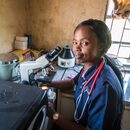
When you enter the Sawa headquarters, the first one to welcome you is Dr. Tamer, who connects a medical consultation with immediate psychological help. His job covers consultations with the callers. For instance, they discuss how to ease physical discomfort, how to care for health in difficult circumstances, and how to find available medicine substitutes, especially when people are starving and do not have even the most essential means.

Photo: DR Tamer connects a medical consultation with an immediate psychological help
I am drawn to the values that Sawa strives for – to protect Palestinian women and children. I consider this extremely important,
Dr. Tamer explains and adds that working for Sawa allows him to be as close as possible to the people on site and in their everyday reality.
Lama is one of the operators of the mental health and psychosocial support hotline. She also views her work for Sawa as highly valuable. When people call to ask where they can receive material help, she provides verified phone numbers and registration links so they can sign up right away.
One time, someone called me and asked: ,Are you from UNICEF?‘ I said no and he was about to hang up, but I managed to stop him and offered help. Then I provided him with the information he needed. I instructed him to get in touch not only with UNICEF, but also to register for additional material assistance,
Lama says. Together with other team members, they answer calls in a modest yet soundproof room with eight cubicles and a supervisor nearby.

Photo: Lama is an operator of the mental health and psychosocial support hotline in Sawa
Their shifts take five hours and can be very busy. The frequency of calls depends on the current situation in Gaza and whether the clients have signal coverage, power, or a secure environment and moment to make the call. Therefore, the team experiences a weird paradox: when there is silence, they get nervous – perhaps the signal was disrupted, or people might be fleeing again. But when the phones start going off, there comes relief.
„It means people are alive, can reach us and most probably were not displaced again. We can check how they are doing and truly help them,“ Lama claims.
The operators explain that the most difficult calls are with people who deal with domestic violence, have suicidal thoughts, or, as parents, cannot provide food for their children.
Amal is another operator of the mental health and psychosocial support hotline in Sawa. She says that the heaviest calls she receives are from people who, after months of violence in Gaza, speak openly about the fact that they no longer have the will or hope to go on.
„It hurts to hear it, and it is challenging to respond to it meaningfully,“ she adds. What helps her is the knowledge that everyone needs support – even the specialists on mental health in Gaza, despite their skills, experience the same pain as civilians. She also tells herself that nothing lasts forever, not even the ache, and that the circumstances can change anytime. „There were many wars before this one – and none of them lasted for eternity,“ Amal believes. „This war will not be an exception.“

Photo: Amal responds to a call from a client in Gaza
Help us support the operation of the crisis hotline
In order for Dr. Tamel to keep consulting medical cases, for Lama to provide verified contacts, and for Amal to say „I am here for you“ to someone on the other end of the line, we need your support.
The fundraising campaign for Gaza continues. Every donation – small or big – helps us resume the psychosocial support, the training of specialists, and the operation of the 164 crisis line.
Caritas Czech Republic also funded the activities of the clinic of Caritas Jerusalem. The clinic offered assistance primarily in basic healthcare, systematic psychosocial support and crisis intervention directly in Gaza.
The humanitarian crisis in Gaza requires our attention, even after the fragile ceasefire was accomplished. Therefore, we continue to monitor the situation and remain available to help.