


December 8, 2025
News
Ethiopia spans across the so-called „Horn of Africa“, which is the easternmost point of the continent, cut off by the Arabian Sea into the shape of a rhino’s horn. According to Jan Líska, the Institutional Funding Coordinator of Caritas Czech Republic, Ethiopia has been placed on the list of priority developing countries that the Czech Republic supports in its Development Cooperation Strategy. In a joint interview, Barbora Ludvíková, Senior Humanitarian and Development Advisor, adds that Ethiopia was not included on this list by accident. “Czechoslovakia collaborated with Ethiopia already in the past. Ethiopian students studied in Czechoslovakia, and Czechoslovakia imported technologies to Ethiopia. We established several breweries and a tannery there,” Barbora explains.
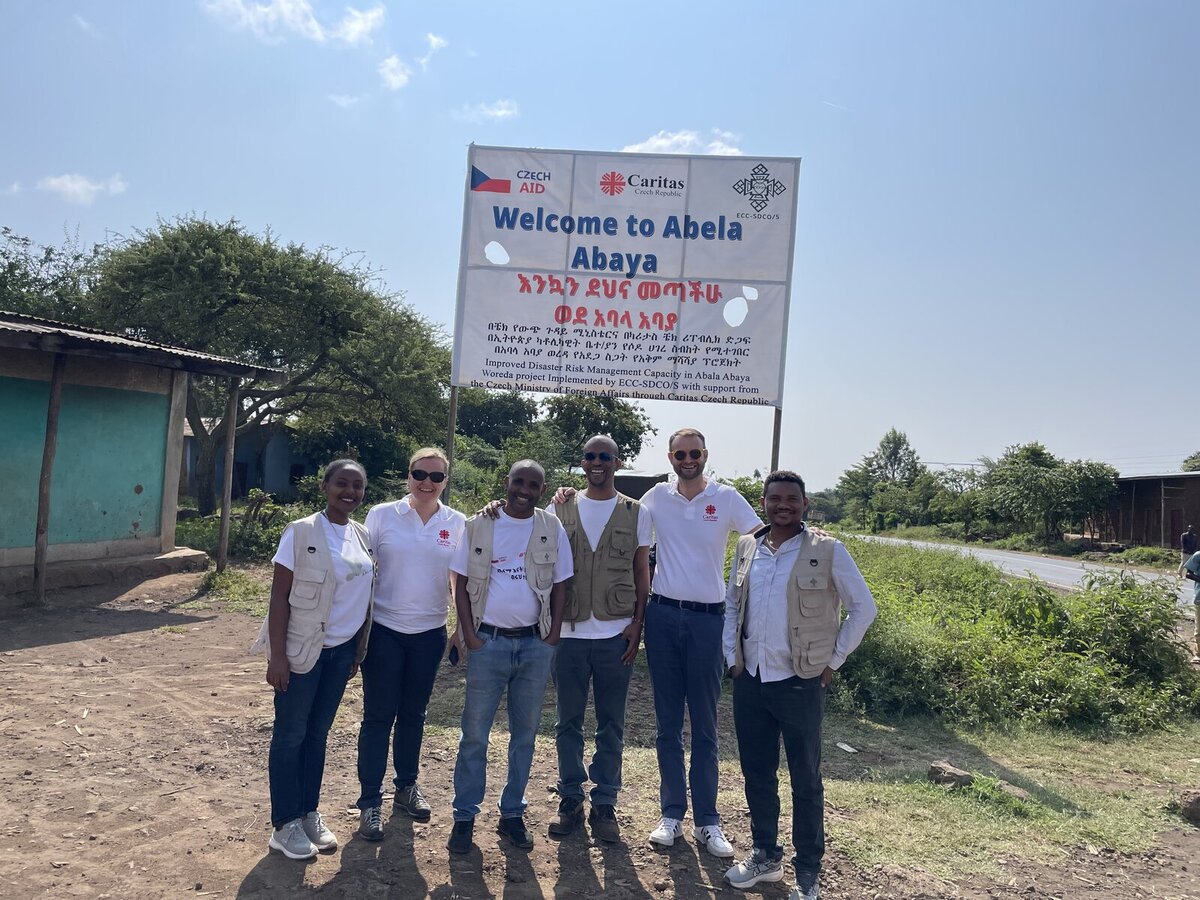
The collaboration between our countries still persists. Funded by the Ministry of Foreign Affairs of the Czech Republic, Caritas Czech Republic operates in southern Ethiopia, where we help implement projects focused on the impacts of climate change. We try to restore access to drinking water and support local farmers in modernisation of their livelihoods. Jan and Barbora visited the area to monitor the ongoing activities and established contacts for future projects.
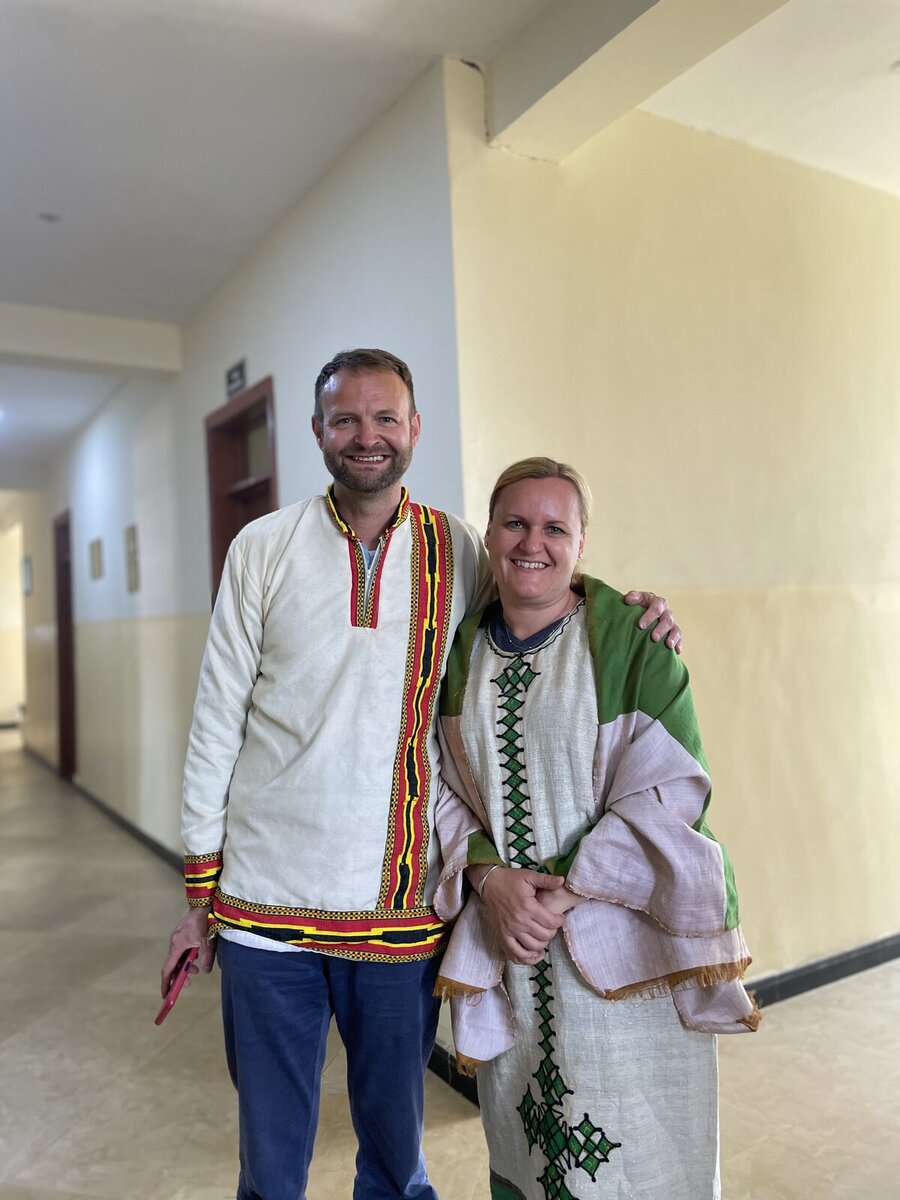
Photo: Jan Líska and Barbora Ludvíková
Traces of climate change are often reflected in sudden natural disasters, such as flash floods and landslides. In July 2024, over 50 people died in the latest massive landslide in the region where Caritas Czech Republic runs it operations. According to Barbora, the event also significantly impacted the traumatised survivors who, as a result of the disaster, lived in fear that the tragedy might reoccur. “The panic of people who lived there was enormous. They were scared to stay. The Ethiopian government partially dealt with the situation by moving some communities to other areas so they would feel safer,” Barbora clarifies, adding that this solution placed considerable pressure on local communities in the relocation areas, as many of them faced challenges in supporting their own livelihoods, even without the arrival of new inhabitants. For example, they often already lacked access to drinking water and their agricultural activities were not sufficiently profitable due to the degradation of local soil.
Moreover, climate change has been further exacerbated by the political instability and a sharp population growth, which contributes to a higher unemployment rate. “Approximately fifteen years ago, over 80 million people were living in Ethiopia. Today, the count has risen to about 130 million. If young people cannot access jobs and basic services, the risk of unrest increases,” Barbora says. Jan adds that Ethiopia is the most populous inland country in the world and the second most populous country in Africa.
Caritas Czech Republic helps restore access to drinking water
Caritas Czech Republic implements two projects in the region of South Ethiopia, where it cooperates with the local branch of Caritas Ethiopia in Soddo. The first project focuses on addressing acute challenges. Its main goal is to restore access to drinking water, so people do not need to spend many hours a day walking to fetch water from far distances. In some parts of South Ethiopia, such a trip could take up to six hours. This poses a burden primarily on women who, according to Barbora, are often responsible for securing water for their households. Additionally, during the walk, they can become the targets of gender-based violence. Therefore, the rehabilitation of local drinking water supply system significantly improves their lives.
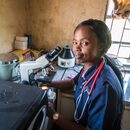
“We assessed the needs of the local community and the capacity of the rehabilitated drinking water supply system, including the yield of the source,” Jan describes the purpose of their work trip. Restoration of water access goes hand in hand with water quality to ensure the sources are clean and safe. Within the project, Caritas Czech Republic also assists in enhancing hygienic and sanitary conditions in the area. “The equipment of the local hospital and health centre does not comply even with Ethiopian standards. Which is why we aim to re-equip these health facilities. This way, they will be able to react more efficiently in the cases of crises,” Barbora points out.

Photo: Jan Líska and Barbora Ludvíková in Ethiopia
Preparing residents for crisis situations
She also refers to the second project through which Caritas Czech Republic supports the local communities in preparing for possible future natural disasters, such as the already-mentioned landslides, floods, droughts, or earthquakes. “Ethiopia is situated along the Great Rift Valley on the boundary of two lithospheric plates. The area contains several lakes, whose water levels have gradually risen in recent years, partly as a result of increased sedimentation, creating a heightened risk of flooding in adjacent areas,” Barbora alerts.
Hence, Caritas Czech Republic supports the local farmers in restoring their livelihoods, helping them become better equipped to face climate challenges. “Once again, we ensure sustainable water access for communities, for example by installing solar panels. We focus on landscape management, the rehabilitation of a degraded soil, which has been damaged, for instance, by unsuitable agricultural practices. We also support the installation of domestic biogas plants,” Barbora shares.
According to Barbora, Caritas Czech Republic also emphasises the importance of supporting women’s self-help groups by providing them with basic investment capital, enabling them to gradually start small businesses. “These activities indirectly strengthen their resilience to crises, bringing them alternative sources of livelihood, which is essential in times when their community has to deal with various shocks,” Barbora explains. Moreover, within their self-help groups, women are able to discuss their concerns and support one another.
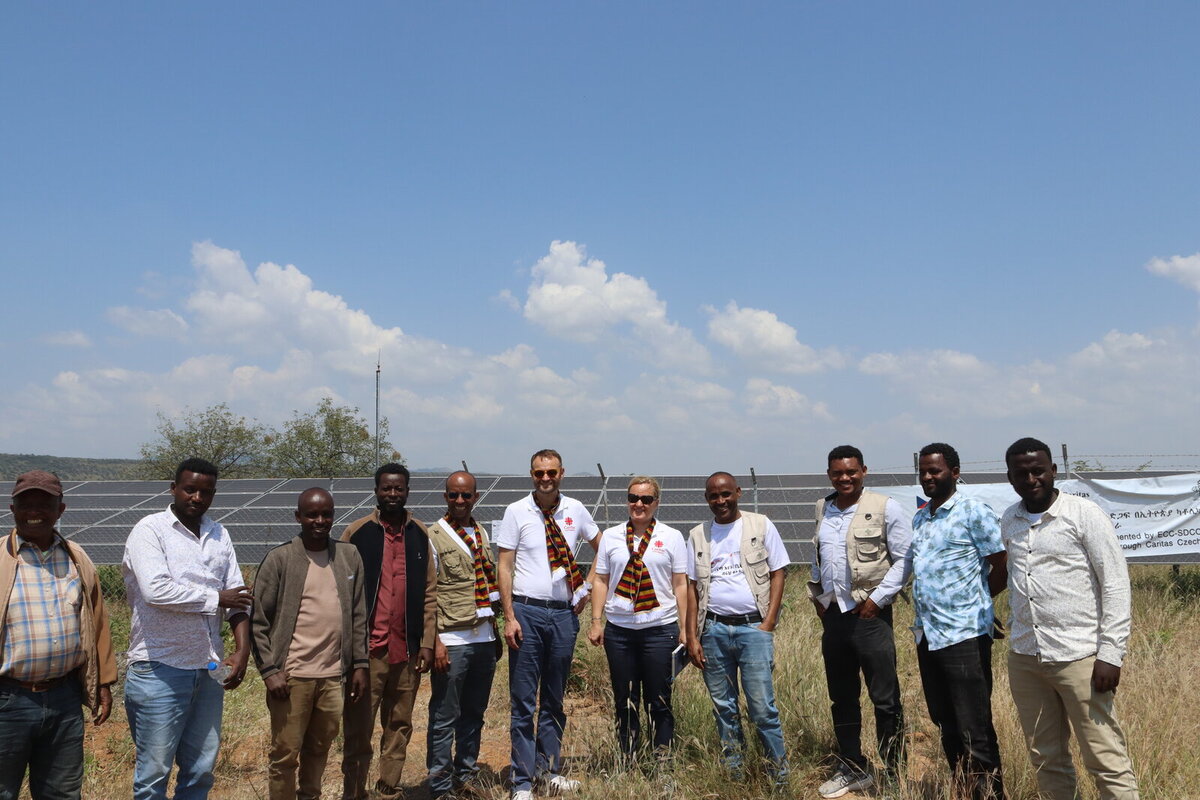
Photo: Jan Líska and Barbora Ludvíková in Ethiopia
Our plans in Ethiopia for the future
According to Jan, Caritas Czech Republic aims to expand its work to other Ethiopian regions and also focus on other sectors, primarily on healthcare. During the work trip, Jan and Barbora visited local health centres, including the biggest maternity hospital in the country. “We would like to implement a project that would strengthen the capacities of local healthcare staff, and simultaneously, upgrade the medical equipment in accordance with the plan of the Ethiopian government,” Jan concludes.