


March 18, 2026
News

Humanitarian aid can be measured in food packages, litres of water, or tons of firewood. But behind those figures, real people’s stories are hidden – stories of those from Eastern Ukraine who, like us today, once owned houses, worked, and raised children. In 2022, they lost everything in a matter of minutes. Many decided to leave their hometowns and move to the relative safety of western Ukraine, such as Ivano-Frankivsk. One of them was Iryna: “People came here with small suitcases. They packed their entire lives into one bag. They constantly follow the news from home. They live in hope of returning, no matter what.” These are their stories.
Valentyna and Yevhen lost their properties and a family farm, but they kept their epileptic dog
Valentyna is a former medical professional, and Yevhen used to work as a driver. They once led a comfortable life, owning two houses and an apartment, and raising two sons – one serving in the army and the other already a father himself. Although they had retired before the war began, they actively managed their own farm and livestock. They kept pigs, geese, sheep, ducks, rabbits, and cows.
In February 2022, their village, which is situated 20 kilometres outside the Kupiansk district of the Kharkiv region, was occupied by Russian soldiers. “Communication and electricity were lost. Bridges were blown up. We were informed that our son had been seriously wounded. We were devastated,” Valentyna recalls.
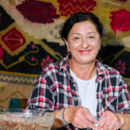
 Photo: Valentyna and Yevhen
Although the Ukrainian army liberated their village in September, the attackers began heavy shelling of the area. Valentyna and Yevhen’s house was destroyed. Consequently, they decided to move to Ivano-Frankivsk, just like their younger son and his family. For six months, they lived in a flat where they could keep their dog, which developed epilepsy because of the war. After half a year, they ran out of savings and had to leave again.
We found this shelter and have been living here for two and a half years. At first, we attended English and digital literacy classes. Now, due to health problems, we have stopped studying. We are grateful for such accommodation. We have nowhere to return to,
Valentyna says that she, together with her husband, continues to live in the accommodation centre, which Caritas Czech Republic helped equip. They both hope that, in time, they will receive compensation for the properties they lost in the east of the country, and they will be able to purchase their own accommodation again.
Olha wishes to return home and restore the lake where she used to relax
Olha, who is also retired, found shelter in the same centre as Valentyna and Yevhen. She comes from Siverskodonetsk in the Luhansk region. “We were bombed with Grad rockets. Tanks were driving around. A tank drove into our neighbourhood. We were sitting near the entrance to the building, and it pointed its barrel at us. I wanted to hide in the entrance, but my friends said that if it fired, neither I nor the entrance would be left standing,” Olha shares her experience. She came to Ivano-Frankivsk in spring 2022, while her city remains occupied.

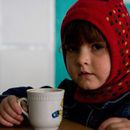
Photo: Olha
Olha spent her first moments in Ivano-Frankivsk living in a sports hall at a local lyceum. Later, she helped clean the accommodation spaces where she eventually moved. She says it is good to be there. She shares a room with another woman from the Luhansk region who has been knitting camouflage nets for the military since 2022. “I tried knitting too, but for some reason I cannot do it,” Olha explains. Like many others, she hopes that one day she will be able to return home.
They say there is no water now. We had a very beautiful lake, everyone went there to relax. The lake has already dried up. In peacetime, we fed it with water, but the Russians are doing nothing.
Despite her own diagnoses, Iryna cares for other residents of the centre
Iryna also dreams of returning home to Chuhuiv in the Kharkiv region, where her mother and brother remain. “Most of the people in this shelter, like me, want to go home. It does not matter whether their homes are still standing or not. People are ready to rebuild their homes brick by brick. Home is home,” Iryna explains. She says that the situation is extremely difficult, especially for people over sixty.
When a person had everything, a house, gardens, a country house, and in a minute everything was gone,
Iryna describes the feelings of the local residents. Together with her child, she spent the first forty days of the war living in a basement, while the Russian soldiers besieged the town. Her family then fled to Ivano-Frankivsk, where her husband started working as a builder and their child, now 15, studies English.

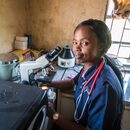
Photo: Iryna
During their first year in Ivano-Frankivsk, the family stayed in a local school. In December 2022, they moved into the same accommodation centre where Olha and Valentyna, along with Yevhen, also found shelter. It was Iryna who became the centre's administrator. Currently, 116 internally displaced persons live there. According to Iryna, most of them are retired individuals or mothers with children.
The accommodation is divided into three buildings. There are five kitchens and twenty-four bathrooms. “Thanks to Caritas Czech Republic, we have the necessary household appliances and kitchen equipment. Women especially love to bake, and children, girls join in this wonderful activity. All the residents and I are very grateful for this,” Iryna says. Caritas Czech Republic provided the centre with, for example, washing machines, dryers, microwaves, or blenders.
“People have organised themselves to clean the common areas. We are planting flowers and plants. We have a projector and sometimes get together to watch films,” Iryna offers a closer look at life in the centre.
However, Caritas Czech Republic helped Iryna not only with her living situation but also with starting a new career. We provided her with a study grant that allowed her to attend hairdressing courses. This marked a significant change for Iryna, who has a technical background and used to work as a metrology engineer in her hometown.
“This is a completely different direction in my life. I never thought that I would do this and enjoy it. Now I have many ideas and would like to continue developing my hairdressing skills. For example, I would like to learn about hair restoration. This is a great incentive and support for me,” Iryna shares. She enrolled in the courses last year after being diagnosed with cancer.
Thanks to the grant, studying became a breath of fresh air for me during my recovery,
Iryna says she has finished the course for men’s haircuts but would like to focus on women’s haircuts as well. She also practises her skills by cutting the hair of other women who live in the centre. “It is very difficult for an 85-year-old grandmother or a mother with many children to pay 500 UAH (approximately 240 CZK) for a haircut. I can offer the haircut for free. For me, it is experience, and for them, it is an opportunity to save money,” Iryna explains.

Photo: Despite the adversity she faces, Iryna does not give up
Her story reminds us that behind every Ukrainian refugee's fate are ordinary people who, even amid war, face worries similar to our own. Iryna also proves that giving up is not an option. Like Olha, Valentyna, and Yevhen, many refugees from eastern Ukraine cling to hope that things will improve and support those around them through this difficult time. And we should be doing our part to help them.
Caritas Czech Republic in Ukraine
Caritas Czech Republic's actitivies in Ukraine are currently facing limited funding opportunities. The government budget has cancelled the resources for humanitarian aid to Ukraine, which were originally supposed to amount to 500 million CZK.
That is why we need your support now more than ever. Please donate to the Caritas for Ukraine fundraising campaign and help us improve the lives of those in need.
We have been operating in Ukraine for many years. In 2025, for example, we improved rehabilitation care in six hospitals near the front line in the Dnipropetrovsk region. Our team supplied the hospitals with high-tech equipment, including virtual reality, which helps people return to everyday life.
We also contributed to establishing a network of mental health centres within the national programme called “How are you?” We set up four mental health centres for children and adults in the regions of Transcarpathia, Lviv, Ivano-Frankivsk, and Dnipropetrovsk. Simultaneously, we helped renovate premises for the Resilience Centre in Truskavets, in the Lviv region, and established the first psychological recovery room in Uzhhorod, Transcarpathia.
Additionally, we offered study and business grants for internally displaced persons in western Ukraine and provided extra lessons for children near the front line who missed out on school due to the war. During the winter months, we also supply households with fuel and deliver winter packages to residents in eastern Ukraine. This year, we helped equip so-called Points of Resilience in three Kyiv schools, where people could warm up and rest.
Thanks you for helping together with us.