November 2, 2026
News

How many times did a teacher ask you to open a window and air out the classroom during a lesson? What many of us take for granted is something countless children in Ukraine have never experienced. Instead, they learn online or in underground schools designed to protect them from attacks. Through the Caritas for Ukraine fundraising campaign, we will help equip two such schools and Ukraine’s very first newly built underground kindergarten. In doing so, we will support a network of ten underground educational centres that already enable children in Kharkiv to continue learning even during air raid sirens. What does education without daylight look like, and how has war reshaped the childhood of an entire generation? In this interview, the headteacher of one of these schools shares her experience.
Life underground
Since the beginning of the war, Kharkiv has been subjected to relentless attacks that have disrupted every aspect of daily life in the city. “Air raid alerts can start early in the morning and continue for hours without an all-clear,“ says Vita Kuzub, the headteacher of a Kharkiv lyceum.

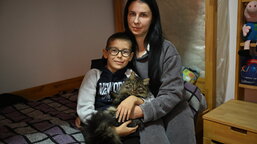
Photo: headteacher Vita Kuzub
While Ukrainian soldiers defend a border just thirty kilometres away, the city’s residents are having to adapt to a new reality. As a result, many seek safety underground. Earlier this year, with public support, we delivered computers to a situation centre located thirty metres below ground, where the city’s emergency services operate together. Now, we are turning our attention to underground schools.
According to Vita, these facilities are the only way to ensure children can continue their education. Teachers do not have to interrupt lessons every time the air raid sirens sound, allowing classes to proceed according to a regular school timetable. Underground schools are therefore gradually replacing remote learning, which has dominated education in the city since the outbreak of the COVID-19 pandemic in 2020. They also provide much-needed relief for parents, who can go to work knowing that their children are safe.
At first, it was hard to understand, but sadly, we can no longer imagine our lives without learning underground,
explains the headteacher, whose lyceum moved its classes underground two years ago. Eight-year-old Yehor has been attending the school for just as long. “In Year 2, I came three times a week. Now I am in Year 3, and I come twice a week,” he says. Together with his classmates, he spends four lessons there each day, focusing on mathematics, Ukrainian language, and reading.
How underground school operate
Yehor’s class alternates attendance with other groups of pupils, who come to the school on the remaining days of the week. In addition to seventeen brightly coloured classrooms, the facility also includes a canteen and dedicated recreation areas. The school is equipped with accessible toilets designed for children with special needs. “These spaces are so modern and well-equipped, thanks to our city authorities and partners, that children simply do not notice that they are underground. We are very glad about that,” says Vita, and Yehor agrees:
It is warm here, my friends are here, and so is my teacher. This is my favourite place. It is lovely here.
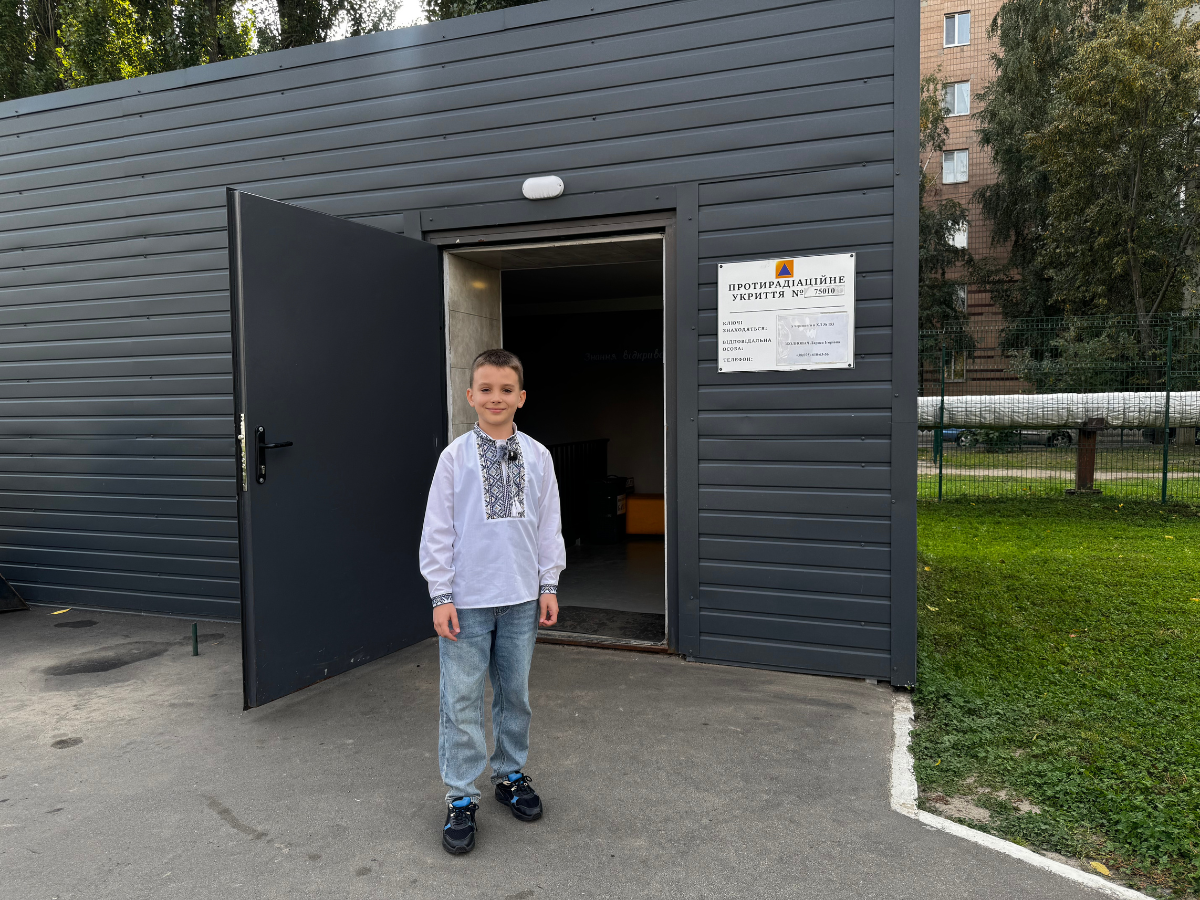


Photo: Yehor showed us around his school
Their school was one of two that have already received a generator from Caritas Czech Republic. According to the headteacher, it is essential to running underground educational facilities. Thanks to the generator, power outages during attacks are no longer a threat, ensuring that both students and staff can always stay warm.
It is extremely powerful and provides a real solution to the challenges we face. Without it, we simply would not have any of these facilities.
We are now planning to expand our support through the Caritas for Ukraine fundraising campaign. We will further equip these two schools and a kindergarten, helping ensure safe learning conditions for more than 3,000 children. We will provide essential furniture, educational and recreational materials, as well as technical equipment.
The impact of war on children's lives
Although the schools are well adapted to meet students’ needs, Vita continues to witness the profound impact the war has on their mental well-being, even during lessons.
Children react to the slightest noise, even to something light falling on the floor. We all flinch at the smallest sound,
she explains. This is also why psychologists play a vital role in underground educational centres, working closely with students and their teachers. “We want to be the safe, trusted adults who can help children experience childhood differently from how they experience it now,” says Vita, highlighting the dedication of teachers in Kharkiv and across Ukraine, as well as their determination to continue educating the next generation.
Their childhood has been lost. There is no doubt about that. Childhood, as it should be, is gone.
Together with Yehor, they confirm that everyone has the same wish, that the war would end soon and they could return to normal schools. “Of course, we want to learn above the ground. We want to see daylight through the windows. We want to feel safe. We do not give up,” she concludes.
 Photo: Despite the war, children want to continue their education
Equip the schools before winter arrives
Right now, we have an opportunity to support children and adults in Kharkiv. All donations made to the Caritas for Ukraine fundraising campaign between 20 October and the end of December will go towards equipping two underground schools and the very first newly built underground kindergarten in Ukraine.
Our support comes at a time when local communities are preparing for another difficult winter. Continued attacks on the energy infrastructure pose a risk of power outages just as temperatures are expected to drop well below freezing. That is why it is crucial to ensure these educational facilities are fully equipped before the crisis unfolds.
Let’s help children feel safe, even if only for a few hours each day. Let’s give them a place to learn, spend time with their friends, and, above all, take a break from the daily realities of life in a war zone.
Donate today. Thank you!