


September 12, 2011
Georgia

Home care is a good way to provide medical and social assistance to those in need, and demonstrates great care and devotion to the people.
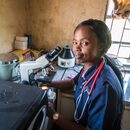
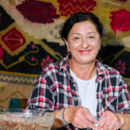
The nurse Anahit jan is unwrapping a plastic bag and empties every piece of its contents: a can of tuna in tomato sauce, a bottle of oil, a packet of pasta, a toilet paper roll, a small packet of washing powder and dry milk. Such humanitarian packages are distributed monthly and their contents are always slightly different. A common feature for all the products delivered is that they must be easy to use. A lot of beneficiaries recognized as home care patient do not have a kitchen.
"Saint" friend
Rosa, Hasmik and Serpui have been friends since childhood. They grew up in an institutional child care centre and when they were old enough to work, they all started to work in a big textile factory in the centre of Gyumri, the second biggest city situated in the north-west of Armenia. The town was battered by a horrifying earthquake in 1988.
As most children that had grown-up in institutional child care, none of these three women got married. They live in a four story house that is used as a dormitory with single rooms. This was a gift from the government. Each room serves as kitchen, bedroom and living room at the same time. The building has a series of collective toilet located in a dark corridor. No showers, no washing machine and, in winter time, there is very often no access to running water and electricity.
Rosa, one of the three women, starts shouting and crying when I enter her room. This is her usual reaction each time she meets someone for the very first time. Rosa is ill and suffering from both mental health problems and chronic physical pain that needs continuous treatment and rehabilitation services, which she likely cannot afford. A nurse comes here three times a month to provide medical assistance. In the meantime caregivers and volunteers come to clean the rooms, wash the dishes or walk with patients if they are willing to and can manage to go down the stairs. Opposite to Rosa’s room lives Hasmik. She is slowly moving from one part of her room to the “kitchen corner”. At one time, I have the feeling Iwas almost did not notice her in the room. As many other cancer patients, she is slowly disappearing by dramatically losing weight.
Serpui, the third woman, is trying to help by permanently running between her friends’ rooms. She goes to Harik’s to ensure the milk is not cooking over then quickly over to Rosa to calm her down when strangers come in. The name “Serpui” means “saint”, which just reflects what she represents for her two sick old friends.
Caucasus' pain – wars, earthquake and passivity of policy makers
Home care services vary in each country. Generally, the core of home care is formed by nursing care provided by trained nurses and social services delivered by social workers, caregivers or volunteers. Very often, there are also doctors and psychologists involved as it is the case in Georgia. In Gori, a town close to the South Ossetia border, a group composed of seven young energetic nurses, two doctors, a psychologist and a series of volunteers visit patients daily at their homes. A great percentage of clients are people who remember at least one armed conflict and thus most of their physical illnesses have a clear link with mental health problems.
The horrifying earthquake of December 1988 in Armenia, the wars in the late 90’s and the recent conflict in Georgia in 2008 mobilized a group of health and social care professionals to serve those that have been left out; single and ill, elderly, handicapped and people in the terminal stage of their life very often living in dire conditions.
While non–governmental organizations are trying to mobilize all possible resources to provide qualified medical and social services for the most vulnerable people of the Caucasus, governments do not seem to be really disturbed by the situation. A call for legislation change made by non-profit organizations to recognize home care as part of primary health care and to enable insurance companies to partly cover the medical expenses has been waiting for a move from decision makers for many years. Of course, in theory, there is still availability for institutional medical care, but, in fact, expenses for hospitalization are comparable with EU countries and thus absolutely inaccessible for a majority of the people. Not even the figures demonstrating the economic advantages that home care services can bring about have succeeded in persuading policy makers to courageously intervene. There are some attempts to slightly balance the passive approach of the governments. For instance, in Gori the local municipalities support home care interventions with a small amount of finances. Although this initiative is appreciated and welcomed, it cannot replace the role of the government in achieving the conceptual change for which they are responsible.
Nice people in a strange place
Karen is 25 years old man with child cerebral palsy diagnosis. He has been a Caritas volunteer for over six years. Caritas is the biggest and probably the only organization providing systematic home care service in Armenia. “What else can I do in a place with 90% unemployment rate and more over with my handicap? No way to find a paid job. I cannot simply sit at home and get old,” explains Karen.
Gyumri is not really a positive place. Temporary houses, so called “domiky” that were constructed as humanitarian aid after the earthquake, are still occupied by those who survived the catastrophe. They have just become twenty years older. Armenia also struggles with great migration flow. Many have left the country, but some devoted and committed people have chosen to stay. For Karen as for other forty people in Caritas, volunteering means responsible work, experience, useful working skills and great company. Moreover, their work is visible and much appreciated by other team members. “Isn’t that a sufficient reason to keep going?” Karen asks.
Footnotes:
The word “jan” means sweet, kind and friendly person you talk to. In Armenian language is a common Shelter – often in type of railway coach