


August 24, 2026
News

On August 24, residents of Ukraine celebrate Independence Day. In the past, it used to be a common public holiday with concerts and a parade in the capital city. However, during wartime, it has become a day that unites people and celebrates the heroism of fallen soldiers and those protecting the country at the front lines. In this interview with Nataly Matskova, the director of Caritas Czech Republic in Ukraine, we take a closer look at the meaning of Independence Day in Ukraine as well as Caritas’s work in the country and the current needs of local people.
On 24 August, Ukraine celebrates Independence Day. What does this event mean to you personally?
Given everything Ukraine has been going through in recent years, I feel that Independence means more than just government decisions. It also lies in very simple things: in the ability to help people around you, to speak your native language, to choose your own future, and to raise your children in the values you share. Independence means remaining human despite circumstances.
I think about the many different people supporting Ukraine's independence today – soldiers, medical staff, volunteers, charity and social workers, teachers and entrepreneurs. They are all doing very important things in their own ways – ensuring their lives and their country do not grind to a halt. Therefore, for me, this day symbolises, above all, unity and gratitude to these people.

How do people in Ukraine celebrate this day? Are there any traditions or community activities?
During peacetime, Independence Day was a public holiday and was marked by lavish concerts and a parade on Khreshchatyk in the capital. Today, due to martial law and the threat of shelling, security restrictions are in place. Instead of parades, destroyed Russian military weapons are displayed in Kyiv on this day. Across the country, local cultural and charitable exhibitions and events are being held on a limited scale. We commemorate the fallen defenders and thank everyone holding the Ukrainian front line.
Has the meaning of this day changed since the Russian invasion in February 2022? Or perhaps, even the annexation of Crimea in 2014?
I think that since 2014, Independence Day has ceased to be just a formal date on the calendar and has taken on greater significance. It has become a reminder that freedom is not a gift that lasts forever. Public opinion surveys show that this holiday is now one of the three most important for Ukrainians, after Christmas and Easter. Loud celebrations gave way to meetings with friends and family, charity events and fundraising for defenders. The focus is now on veterans, volunteers and the families of fallen soldiers. The Ukrainian language, the blue-and-yellow flag, the trident and the vyshyvanka have become symbols of civic commitment and proud identity. On this day, they unite Ukrainians both at home and abroad.
What qualities or values do you see in Ukrainian communities that make you proud to be Ukrainian?
For many years, we have been working closely with communities both in western Ukraine and near the front line in the east. Each of our charitable projects is carried out with the active involvement of local authorities, local partner organisations and institutions. This support and coordination enable us to respond more effectively and rapidly to the impact of the war.
As a result, doctors at six front-line medical facilities in the Dnipropetrovsk region are now provided with the latest equipment and European expertise in patient rehabilitation. Amid ongoing evacuations from the front line, we are working with local communities to set up temporary accommodation and provide the necessary psychosocial support.
Another example of successful cooperation is our work to strengthen five mental health centres for children and adults in the Lviv, Ivano-Frankivsk, Zakarpattia and Dnipropetrovsk regions. We are proud of every such collaboration and the responsibility and unity of Ukrainian communities.

Photo: Nataly Matskova
What would you like the Czech people to know about the life of people in Ukraine affected by the current war?
I would like, first and foremost, to thank the people in the Czech Republic for their active support. This is greatly appreciated and respected in Ukraine. The most important thing, in my view, that Ukrainians need in the fifth year of the war is decisive and timely support from the international community. We may be facing another harsh winter without heating or electricity, with freezing temperatures and massive attacks. We are already receiving requests from the regions for critically important equipment. So today, charitable aid must be stepped up.
What programme that Caritas Czech Republic implements in the country do you consider the most crucial?
I consider all our programmes to be crucial. After all, they provide a lifeline for thousands of war-affected people who have lost their homes, loved ones, jobs, health and normal lives. Our current focus is on developing an effective mental health referral system and supporting local organisations and communities near the front line. However, as I mentioned before, winter aid is also critical. We remember how, the previous winter, over half a million residents of Kyiv were cut off from heating and electricity after their thermal power stations were destroyed. Our response was immediate. With funds from the ‘Caritas for Ukraine’ crowdfunding campaign, we purchased and sent generators and other essential equipment to Kyiv’s ‘points of resilience’. Thanks to this, people were able to keep warm and survive the cold. Frontline communities in the Dnipropetrovsk region, as well as residents of Lviv and Kharkiv, also received the necessary winter aid. Yet another vital challenge lies ahead for all of us.
What has your role as the head of the office of Caritas Czech Republic in Ukraine taught you? Is there anything you have discovered about yourself?
This job has taught me that nothing is impossible (laughs). I have come to realise that I have a wonderful team which is not afraid of challenges or danger. This work has taught me to trust my team and transformed my understanding of the word ‘help’. Today, I see help more as a way of restoring people’s strength and their ability to influence their own lives.
This has convinced me that it is important not to make people dependent on support, but to help them rebuild their own resilience, dignity and self-reliance.
Another conviction I’ve gained is this: when it’s difficult or impossible to make global changes, it’s worth starting with the things we can change right here and now. To do this, we must engage and consolidate the efforts of local partners. This is precisely where I see the strength of our team and our charitable work in times of crisis.


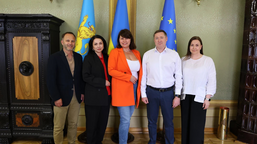
Photo: The team of Caritas Czech Republic in Ukraine
Looking ahead, what are your hopes for Ukraine and the next generations?
I once asked a teenage girl what she would like to change in Ukraine after the war. I expected to hear about safety, roads, jobs, and so on. But she thought for a moment and said, ‘I want people to be able to plan their lives ten years ahead again’.
It was that phrase – ‘ten years ahead’ – that stuck in my mind, because, I suppose, the future doesn’t begin with major reconstruction projects. It starts when people allow themselves to plan their lives again, rather than simply hoping that tomorrow will come. That is exactly what I want for Ukraine after victory.